English
 English
 русский
 Español
Regular Style Multiple Colors Marker Pen
The Regular Style Multiple Colors Marker Pen is designed for individua...
Read More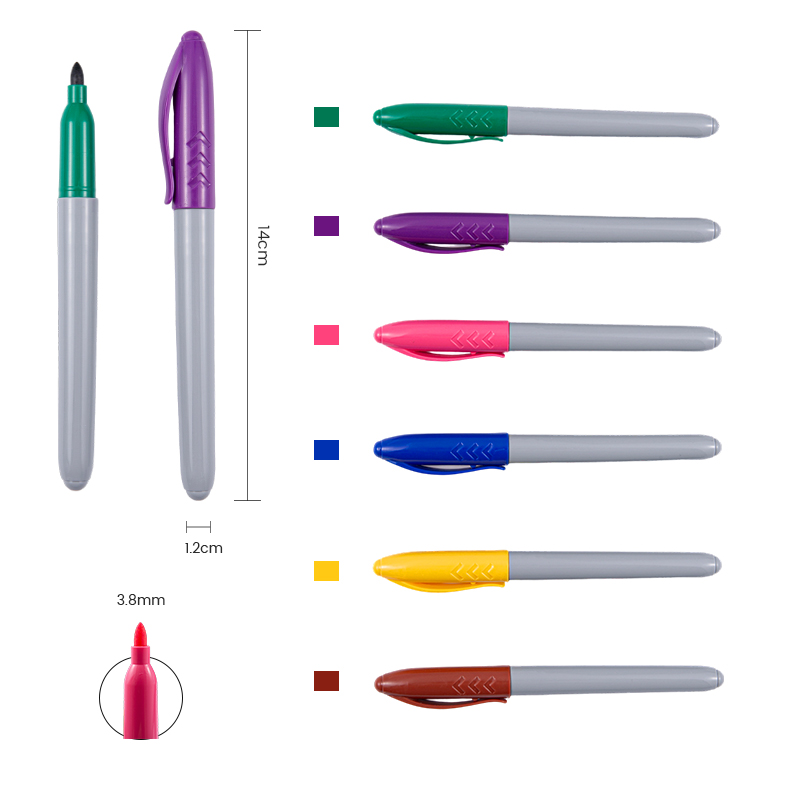
The Regular Style Multiple Colors Marker Pen is designed for individua...
Read MoreA marker pen is an essential tool for professionals, students, and artists who require a reliable and high-quality writing instrument. Whether used for presentations, creative projects, or everyday writing, a marker pen delivers vibrant color, smooth ink flow, and long-lasting performance.
Special Ink QualityOne of the protruding features of this marker pen is its high-quality ink. Designed to perform well, the ink provides rich pigmentation that ensures bold and clear lines. The quick-drying formula prevents smudging, making it a good performance choice for both right-handed and left-handed users. Additionally, the ink is resistant to fading, ensuring that notes, drawings, and labels remain legible over time.
Durable and Reliable. The tip of this marker pen is crafted to provide consistent and smooth writing. Whether it is a fine tip for detailed work or a broader tip for bold strokes, the design ensures durability and precision. The sturdy tip resists fraying, even with frequent use, maintaining its shape for extended periods. This feature makes the marker pen suitable for writing, sketching, and highlighting key points in documents.
Versatile Applications: A marker pen is an incredibly versatile tool, useful for various tasks across different fields. It is ideal for office work, helping professionals annotate documents, brainstorm ideas, and create clear presentations. In the academic setting, students benefit from its ease of use for note-taking and organizing study materials. Artists and designers appreciate the marker pen for its ability to produce vibrant and expressive artwork. Whether used on paper, cardboard, or other surfaces, it consistently delivers reliable performance.
Comfortable and Ergonomic Design Designed with user comfort in mind, this marker pen features an ergonomic grip that reduces strain during prolonged use. The lightweight yet sturdy body ensures a firm hold, allowing for better control and accuracy. Whether writing for extended periods or creating intricate designs, the comfortable grip makes it a good performance choice for all users.
Long-Lasting Performance marker pen is designed to last, with an ink reservoir that provides extended usage. Unlike low-quality alternatives, it does not dry out quickly, even if left uncapped for short periods. The consistent ink flow ensures smooth writing from the preliminary stroke to the last, to a small extent, interruptions during work or creative sessions. This durability makes it a cost-effective choice for both personal and professional use.
Non-Toxic and Safe for All UsersSafety is an important consideration when choosing a marker pen, especially for students and young learners. This product is made with non-toxic, low-odor ink that meets safety standards. It is safe to use in classrooms, offices, and homes, providing peace of mind for parents, teachers, and professionals alike.
Available in Multiple ColorsFor those who need variety, this marker pen comes in multiple vibrant colors. Whether highlighting key information, creating colorful artwork, or organizing notes, the range of colors enhances creativity and organization. The colors remain vivid and do not fade easily, making them a good performance choice for long-term projects.
Conclusion: A marker pen is an indispensable tool for writing, drawing, and marking important details. With its good-quality ink, durable tip, and ergonomic design, this product provides a good writing experience. Whether used in a professional setting, academic environment, or for creative projects, the marker pen stands out for its versatility, reliability, and comfort. Choose this high-quality marker pen to enhance productivity and creativity in your daily tasks.
Zhejiang Meibao Stationery Co., Ltd. is Wholesale Marker Pen Manufacturer and China Marker Pen Factory, and has over 20 years of experience in the Stationery field mainly engaged in producing and selling Watercolor pens, fine liners, Highlighter, and Markers, It insists on a "quality first, reputation first" business purpose, and hold the tireless hard work of faith to make our production technology and product quality reached a new level. The factory has passed the BSCl WCA audit and the products are in conformity with European CE, EN71-1/2/3/9/11, BS7272, REACH, PAHs, MSDS, and American LHAMA, ASTM-D4236 safe standard testing requirements and are sold in America, Europe, the Middle East, and Southeast Asia Highly praised by customers.

In recent years, everyday writing tools have evolved beyond simple functionality and are now becoming creative instrumen...
Creative writing tools are experiencing a resurgence as more people rediscover the joy of artistic expression through si...
Personal journaling has evolved far beyond simple diary writing. Today, it has become a creative lifestyle activity embr...
Creative expression has always evolved alongside new tools and materials. Recently, social platforms have seen a renewed...
The humble marker pen, a staple in offices, classrooms, and studios worldwide, is far from a singular tool. Its evolution from simple felt-tip designs has resulted in a diverse family of instruments, each engineered for specific tasks and creative expressions. This diversity caters to a wide array of preferences and practical needs, from the bold, indelible lines required for industrial labeling to the subtle, blendable hues sought by illustrators.
People commonly favor different types of marker pens based on their intended use, which generally falls into artistic, practical, or specialized domains. Popular categories include:
A permanent marker refers to a writing instrument containing ink formulated with pigments or dyes suspended in a solvent mixture, commonly xylene, toluene, or alcohol. This formulation is designed to be fast-drying and resistant to water, fading, and smudging once it has adhered to a surface. The term "permanent" indicates a degree of durability, though it is not absolute; the marks can often be removed from non-porous surfaces with specific solvents like rubbing alcohol or acetone. The ink is typically housed in a porous felt or nylon tip, which can be shaped as a bullet, chisel, or fine point to vary line width.
The use of permanent markers is extensive due to their versatile adhesion. A primary function is labeling and identification. They are routinely used to mark cardboard boxes, plastic bins, fabric labels, and hardware, creating lasting identifiers that withstand handling and storage. In the realm of arts, crafts, and customization, their opaque ink allows for decorating surfaces like ceramics, glass jars, rocks, canvas shoes, and plastic models. Their ability to write on glossy, non-porous materials makes them indispensable for this purpose. Furthermore, in industrial and retail settings, permanent markers serve practical roles for inventory coding, pricing on non-paper tags, and making quick, durable notations on machinery, tools, or construction materials. Their utility stems from providing a reliable, semi-permanent mark on an exceptionally wide array of materials.
The availability of marker pens in coordinated multiple-color sets transforms them from simple writing tools into comprehensive systems for organization and artistic creation.
Multi-color sets are powerful tools for visual management. In planning, note-taking, and data analysis, different colors can be assigned specific meanings to create instant visual categorization. A student might use one color for main ideas, another for supporting details, and a third for questions in their lecture notes. A project manager could color-code tasks on a whiteboard by department or priority. This use of color enhances comprehension, recall, and the efficient sorting of information by creating a clear, color-based logical structure.
For artists and hobbyists, a set of multiple colors provides a ready-made palette that encourages experimentation and creativity. Unlike paints, which require mixing and cleanup, markers offer immediate color application. This accessibility is particularly appealing for illustration, hand-lettering, manga, and fashion design, where flat, vibrant areas of color are desired. Layering and blending techniques can also be explored with certain alcohol- or water-based sets, allowing users to create gradients, shadows, and depth without needing a full studio setup.
For children, multi-color markers are fundamental tools for development. The range of colors stimulates engagement and makes learning activities more enjoyable. Using different colors helps in early education lessons—such as distinguishing parts of speech, mapping geographical regions, or understanding mathematical sets—by making abstract concepts visually concrete. Furthermore, the act of selecting and applying colors aids in the development of fine motor skills, color recognition, and personal decision-making, turning creative play into a multifaceted learning experience.

TEL & Whatsapp: +86-15773630590
TEL :
+86-13676769913
+86-17385445716(claire)

E-mail :
[email protected]
[email protected]
[email protected]