

 English
 English
 русский
 Español
- Type:
- Company News
- Date
- 2025-Mar-31
Company News
Shimmer & Shine: The Magic of Glitter Color Markers
In the world of art and creativity, few tools can captivate the imagination quite like glitter color markers. These dazzling markers add a shimmering touch to artwork, making them a favorite among artists, students, and DIY enthusiasts. Whether you're creating handmade cards, designing eye-catching posters, or adding sparkle to your bullet journal, glitter markers can transform any project into a masterpiece.
.jpg)
What Are Glitter Color Markers?
Glitter color markers are special writing and drawing tools infused with glitter particles, giving the ink a luminous and vibrant effect. They come in a variety of colors and finishes, including metallic, pastel, and neon, offering limitless creative possibilities. Unlike standard markers, glitter markers provide a shimmering stroke that catches the light beautifully.
Why Choose Glitter Markers?
Vibrant & Sparkling Colors – These markers are designed to make the artwork stand out with their glittery brilliance.
Smooth Application – High-quality glitter markers glide effortlessly on paper, canvas, and other surfaces without smudging.
Versatile Usage – Ideal for school projects, scrapbooking, journaling, greeting cards, and DIY crafts.
Non-Toxic & Safe – Most glitter markers are made with non-toxic, water-based ink, making them safe for kids and adults alike.
Long-Lasting Effect – Unlike loose glitter that can rub off, glitter markers provide a lasting shimmer that stays in place.
Top Uses for Glitter Color Markers
DIY Greeting Cards: Add a festive and glamorous touch to holiday and birthday cards.
Bullet Journaling & Planners: Highlight important notes with a sparkle that stands out.
Scrapbooking: Enhance photo albums with dazzling decorations.
Hand Lettering & Calligraphy: Give words an elegant, shimmering effect.
School Projects: Make presentations and posters more visually appealing.
Glitter art markers have secured a prominent place in the craft supplies of many children, offering a unique blend of color, texture, and sheer delight. Unlike traditional markers or loose glitter with its notorious mess, these pens encapsulate fine, suspended glitter particles within a water-based or gel ink, delivering shimmer with relative control. Their popularity among young users is not merely a matter of superficial appeal; these tools intersect with key aspects of child development, creative expression, and practical usability.
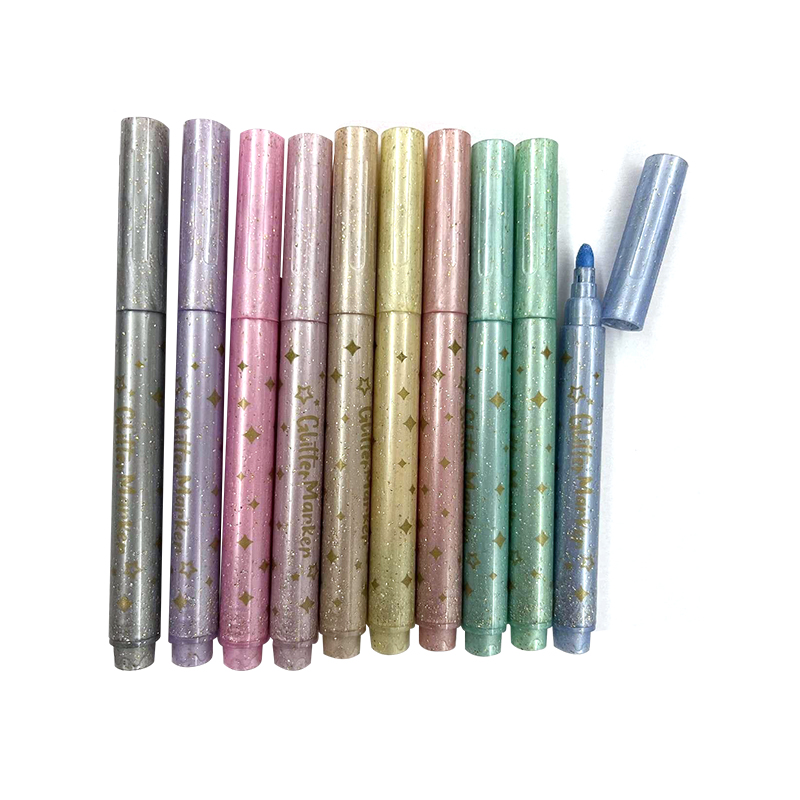
Fostering Sensory Engagement and Fine Motor Skills
The visual feedback they provide—a gleaming, textured line that catches the light—offers a heightened level of reward for a child's efforts. This immediate, positive reinforcement can encourage prolonged engagement with an art activity, building focus and patience. Furthermore, the physical act of using these markers supports fine motor development. While similar to using a standard marker, many glitter inks have a slightly thicker viscosity, requiring consistent, moderate pressure to achieve a smooth flow. This practice helps strengthen the small muscles in the hands and fingers, refining the pincer grip and control essential for writing. The desire to create specific shapes or contain glitter within outlined areas also promotes hand-eye coordination and deliberate movement, turning a fun activity into a subtle exercise in dexterity.
- Unlocking Imaginative Expression and Confidence
Beyond motor skills, glitter markers serve as powerful tools for imaginative play and emotional expression. The sparkle itself is often associated with magic, celebration, and special occasions in a child's mind. By providing access to this element, the markers empower children to infuse their ordinary drawings—be it a family portrait, a fantastical creature, or an abstract design—with a sense of wonder and importance. This can be particularly effective for children who may feel less confident in their representational drawing abilities; the attractive quality of the glitter can boost their pride in the finished work, shifting focus from precise accuracy to joyful decoration. The markers thus become a vehicle for storytelling and emotional communication, allowing a child to designate what in their artwork is "shiny" and worthy of extra attention, building narrative thinking and self-esteem.
- Practical Considerations for Caregivers
From a practical standpoint, glitter markers represent a notable compromise between creative desire and manageable cleanup—the "contained glitter" principle. Compared to pots of loose glitter and glue, they significantly reduce the risk of widespread, persistent mess, making them a more feasible option for home or classroom use. However, they are not without their considerations. Adult supervision is often advised for younger children to prevent accidental marks on clothing or furniture, as some glitter inks can be difficult to remove once dry. Additionally, the quality of markers varies; lower-cost options may have uneven glitter distribution or tips that clog easily, frustration. Informed selection of washable, non-toxic formulas with durable tips can enhance the experience. Ultimately, their practicality lies in their ability to deliver a highly-desired creative effect while imposing boundaries on the potential for chaos, making art time enjoyable for both the child and the supervising adult.
A Lustrous Choice: Understanding Metallic and Glitter Markers
Metallic and glitter markers often grouped together under the broad category of “shiny” pens. However, they produce distinctly different visual and tactile effects, and understanding their core differences is key to selecting the right tool for a specific task. While both aim to elevate a design beyond flat color, their composition, finish, and applications diverge significantly. This essay will clarify these distinctions and provide a practical framework for choosing between them, ensuring that the final result aligns with the creator's vision.
The primary difference between metallic and glitter markers lies in their fundamental composition and the resulting surface quality. Metallic markers contain ink with fine, ground metallic or pearlescent pigments suspended in a liquid base (often water-based, alcohol-based, or oil-based). When applied, these pigments lay flat and create a smooth, lustrous finish that mimics the continuous sheen of polished metal, such as gold, silver, copper, or bronze. The effect is uniform, reflective, and relatively flat to the touch. In contrast, glitter markers are formulated with a clear or tinted gel or glue base that holds visible, discrete particles of glitter—typically plastic or foil—in suspension. The result is a textured, sparkling line where individual glitter flecks catch the light from different angles, creating a granular, three-dimensional sparkle. The dried result is often raised and gritty to the touch.
.jpg)
These compositional differences divergent practical characteristics and better-use scenarios:
Visual Effect:
- Metallic: Provides a smooth, shiny, reflective finish with a satin or polished metal look.
- Glitter: Creates a textured, sparkling, dimensional effect with discrete points of light.
Opacity & Coverage:
- Metallic: Generally offers good, opaque coverage, especially on dark papers, as the pigments are dense.
- Glitter: Often more translucent; the base may be clear or lightly tinted, with sparkle density varying by brand. Full coverage usually requires multiple layers.
Drying Time & Texture:
- Metallic: Dries relatively quickly to a smooth finish.
- Glitter: Has a longer drying time due to the thicker gel base and dries to a distinctly textured, raised surface.
Key Applications:
- Metallic: Ideal for elegant lettering, accents on stationery (e.g., wedding invites), technical drawings requiring metallic lines, illustrating metallic objects, and marking on dark paper.
- Glitter: Good for festive decorations, holiday cards, children's crafts, party signage, adding playful accents to fashion sketches, and projects where a fun, tactile sparkle is desired.
How should we choose between them?
The choice between metallic and glitter markers is not a matter of which is objectively better, but which is more suited to the project's aesthetic, functional, and practical requirements.
Define the desired aesthetic. For a project that calls for sophistication, sleekness, or a realistic metallic sheen—such as highlighting a logo, doing modern calligraphy, or adding details to a automotive sketch—a metallic marker is the appropriate tool. Its smooth reflectivity conveys a professional or elegant tone. Conversely, if the goal is to evoke celebration, fun, or magical whimsy—as in a birthday card, a child's art project, or carnival posters—a glitter marker's textured sparkle will deliver the intended joyful and playful impact.
Consider the project's function and durability. Due to their smooth, often sealed finish, metallic ink can be more resistant to smudging and wear once fully dry. For items that will be handled frequently, such as a personalized bookmark or a labeled storage box, metallic markers may hold up better. The textured surface of glitter markers, however, is more vulnerable to flaking or being scraped off over time. They are better suited for decorative pieces, like framed art or seasonal decorations, that will be displayed but not routinely touched.
Account for the working surface and medium. Metallic markers often perform well on a wider variety of surfaces, including paper, plastic, metal, and glass, depending on the formulation (e.g., oil-based for non-porous surfaces). Glitter markers, with their thicker gel base, are primarily designed for paper, cardstock, and other porous materials where the adhesive base can properly anchor. Additionally, if the project involves layering or combining with other media, the flat surface of metallic ink is easier to write or draw over, whereas glitter's texture can interfere with subsequent fine detail work.
Related Products
-
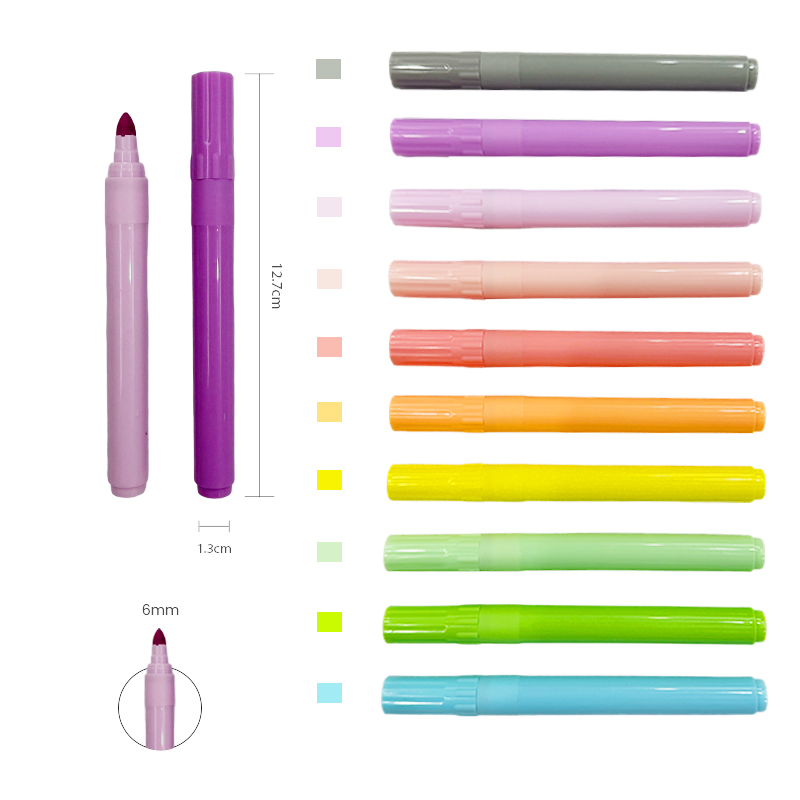
High-Opacity 6mm Round-Tip Watercolor Marker
Product Overview The High-Opacity 6mm Round-Tip Watercolor Marker stands out for its high-coverage gouache ink that colors directly on dark paper – ...
View More -
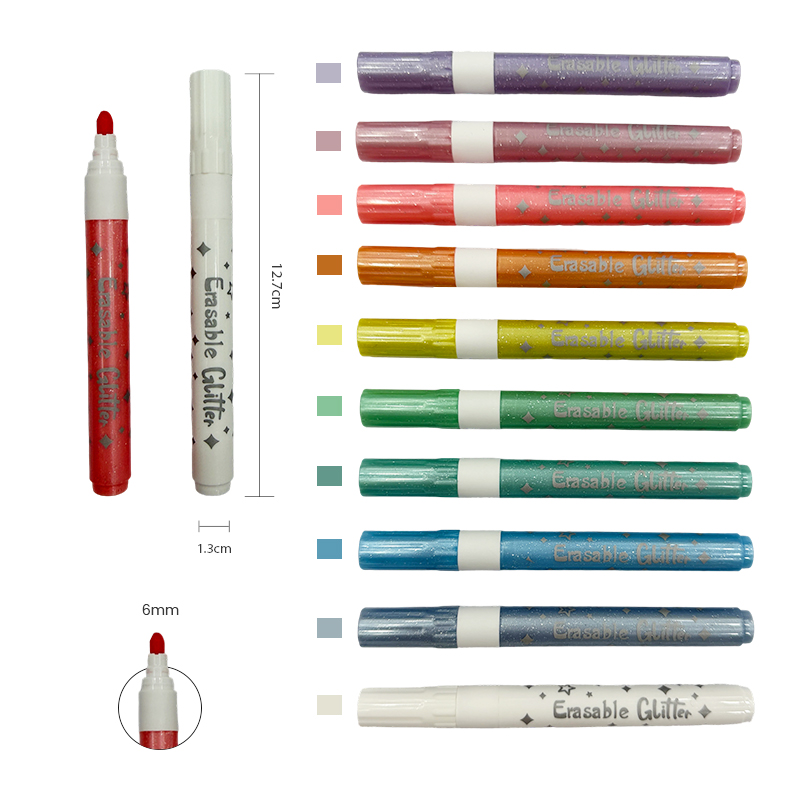
Eco-Friendly 6mm Round-Tip Erasable Highlighter Pen
Product Overview The Eco-Friendly 6mm Round-Tip Erasable Highlighter set includes 9 shimmering colored pens plus 1 dedicated white eraser pen. Featuri...
View More -
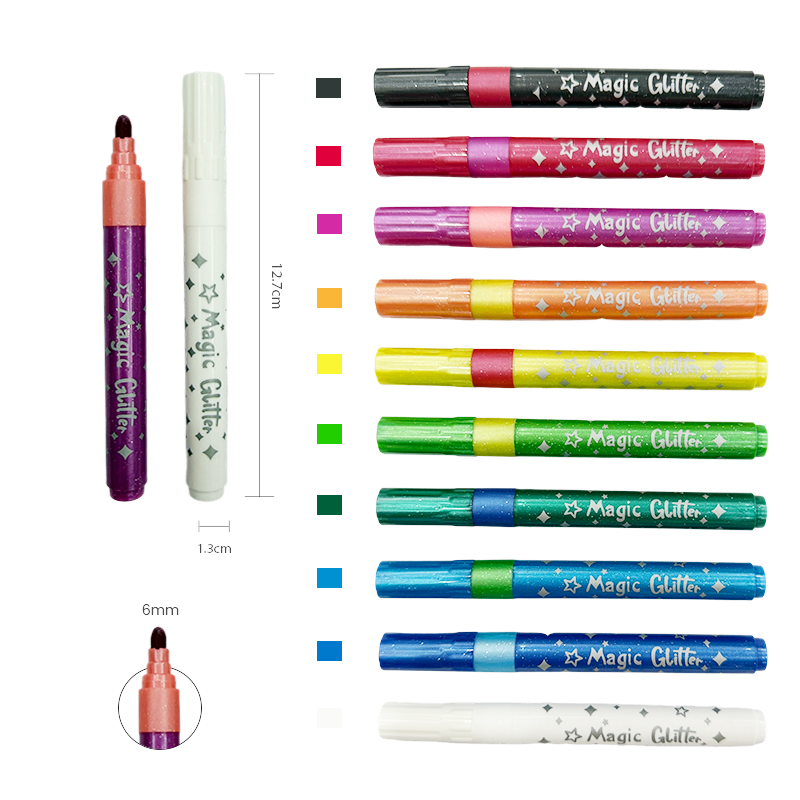
Children's Creative Magic Color-Changing Highlighter Set
Product Overview The Children's Creative Magic Color-Changing Highlighter set includes 9 shimmering colored pens in different color families plus 1 de...
View More -
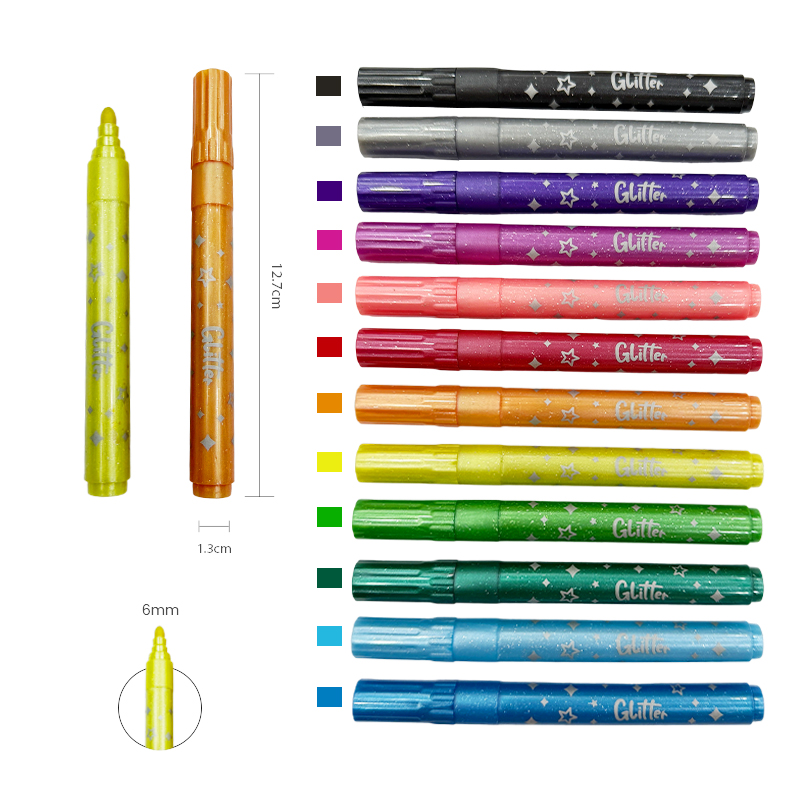
Vibrant 12-Color Single-Tip Highlighter Pen
Product Overview The Vibrant 12-Color Single-Tip Highlighter Pen set includes 12 single-tip shimmering colored pens filled with water-based glitter in...
View More -
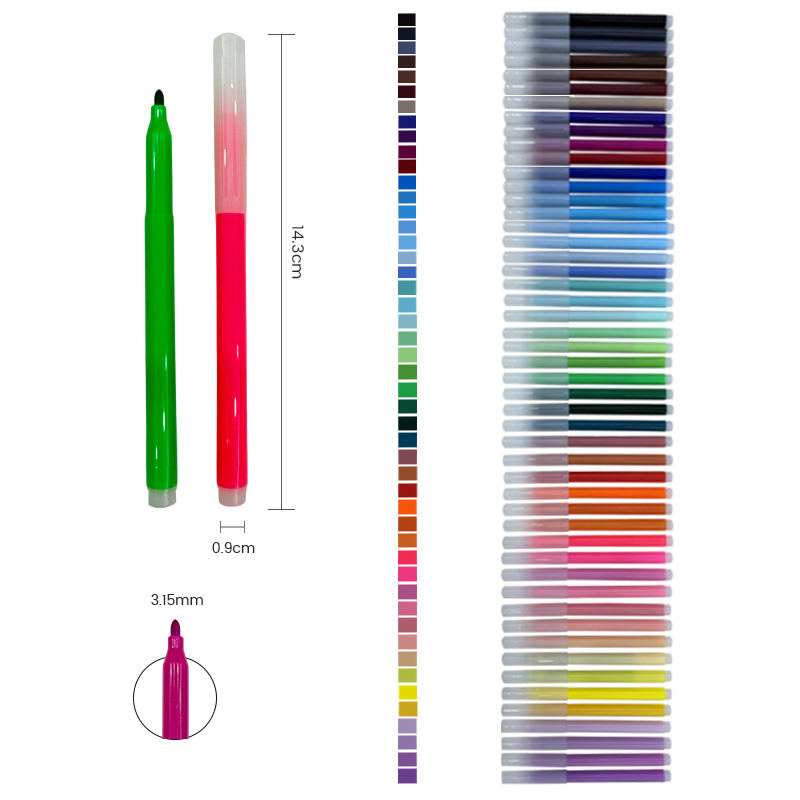
812-50 Smooth-Flowing 50-Color Watercolor Marker
812-50 Smooth-Flowing 50-Color Watercolor Marker is suitable for Art enthusiasts and students. 1. Core Advantages (3-in-1 Value Proposition) Smooth In...
View More -
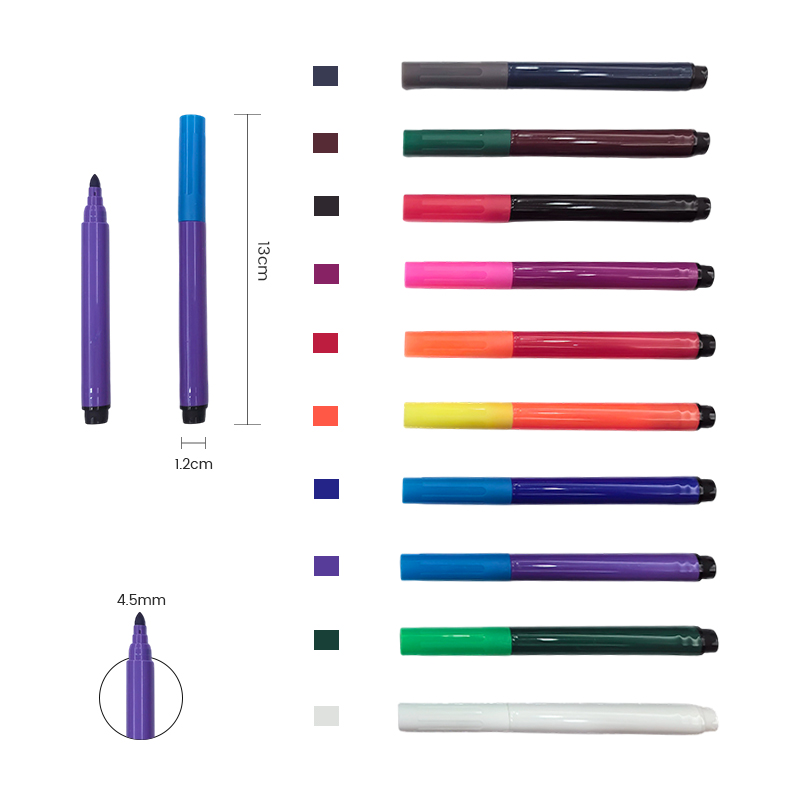
801M-10 Two-Tone Barrel Magic Markers for School
Designed to spark children's creativity and curiosity, these 801M-10 Two-Tone Barrel Magic Markers for School feature a unique characteristic: the ink...
View More -
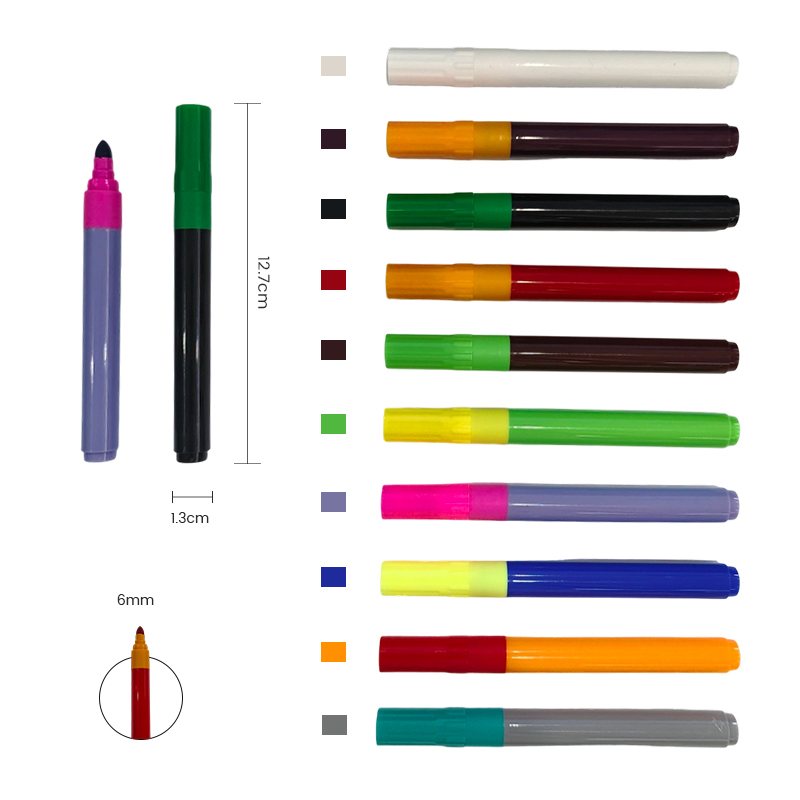
806M-10 Color Changing Magic Markers
806M-10 Color Changing Magic Markers are a set of fun drawing tools designed for children, students, and creative enthusiasts, combining three core fe...
View More -
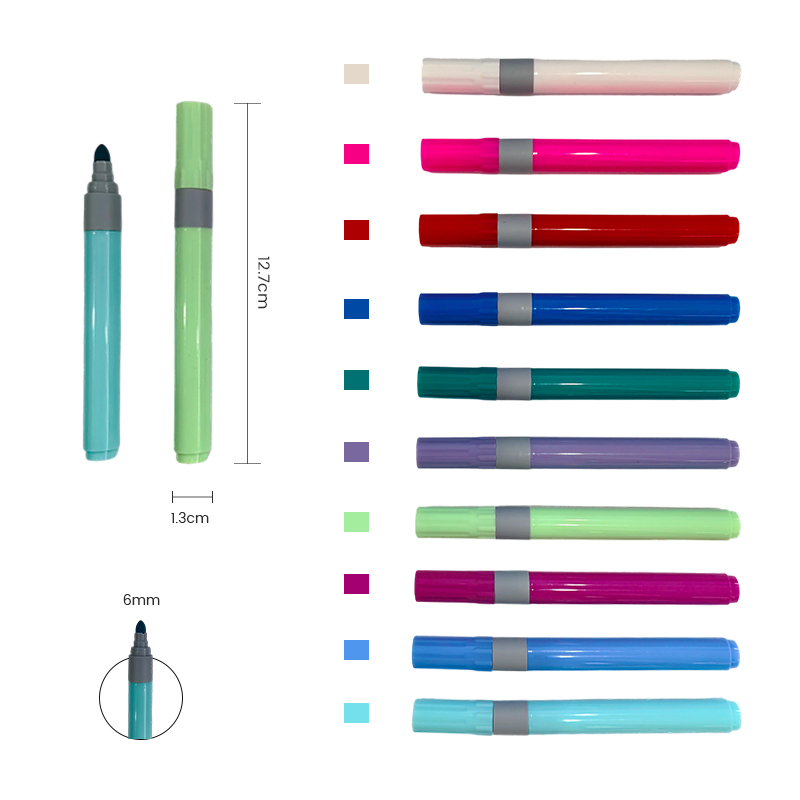
806E-10 Washable Erasable Magic Markers for Kids Drawing
Designed for children, students, and journaling enthusiasts, these magic markers combine three key advantages: safety and non-toxicity, vibrant colors...
View More


Information
-

TEL & Whatsapp: +86-15773630590
TEL : +86-13676769913
+86-19519895579 -

E-mail : [email protected]
[email protected]
[email protected]
[email protected] -
 Building 18-1, Lot 9, Wanyang Zhizao Town, Bihu Town, Liandu District, Lishui City, Zhejiang Province, China
Links
Contact Us
